When a paragraph feels boring you probably think you need better ideas. Sometimes that is true. Many times the idea is fine. The problem is that every sentence hits with the same weight.
You can fix that without rewriting everything from scratch. You can take a paragraph that already says what you mean and rebuild its rhythm so the right parts carry emphasis and the rest quietly support them.
This is a skill you can practice. You can learn to revise using only rhythm and emphasis and you can do it without AI touching a single line for you.
What Rhythm And Emphasis Actually Mean On The Page
Rhythm is the pattern of your sentence lengths and pauses. Emphasis is where you place stress. In speech you use volume and tone. On the page you use position, contrast and silence.
If every sentence in your paragraph is the same length, you give every idea the same importance. Your reader cannot tell what to care about. The paragraph becomes a bucket of information instead of a path the eye wants to follow.
When you shape rhythm, you guide attention. A shorter sentence after a longer one feels sharper. A longer sentence after a string of short ones feels like a deep breath. Emphasis lives at those turning points.
The Before Paragraph: Flat But Not Wrong
Here is a typical flat paragraph. It is not terrible. It is just lifeless.
“Revision is an important step in writing because it helps you clarify your ideas and remove weak spots in your work. Many writers avoid revision because it feels time consuming and repetitive. If you learn a simple process for revising, it becomes easier to improve your paragraphs and feel confident about your final draft.”
The ideas are fine. You agree with them. Still, your eyes might slide off the lines. The sentences are all similar in length. The emphasis is soft. Nothing stands out as the line you remember.
Your goal is to keep the same meaning and change how it feels. You will revise using rhythm and emphasis only.
Step 1: Decide What The Paragraph Should Do
Before you touch a word, ask why this paragraph exists. If you skip this, you risk polishing a shape that never fits the piece.
Ask yourself three quick questions:
- What does this paragraph need to say
- What should the reader feel while reading it
- What single idea should be the most memorable
For the example paragraph, maybe your answers look like this:
- It needs to say that revision matters and can be easier with a clear process
- The reader should feel encouraged, not judged
- The most important idea is that revision becomes easier when you follow a simple method
Now you know what should get emphasis. You know what rhythm to aim for. Calm and encouraging with a clear final note.
Step 2: Map The Rhythm You Already Have
Next you need to see what you actually wrote. This is where your instinct often lies to you. Your brain remembers what you meant. It forgets what you put on the page.
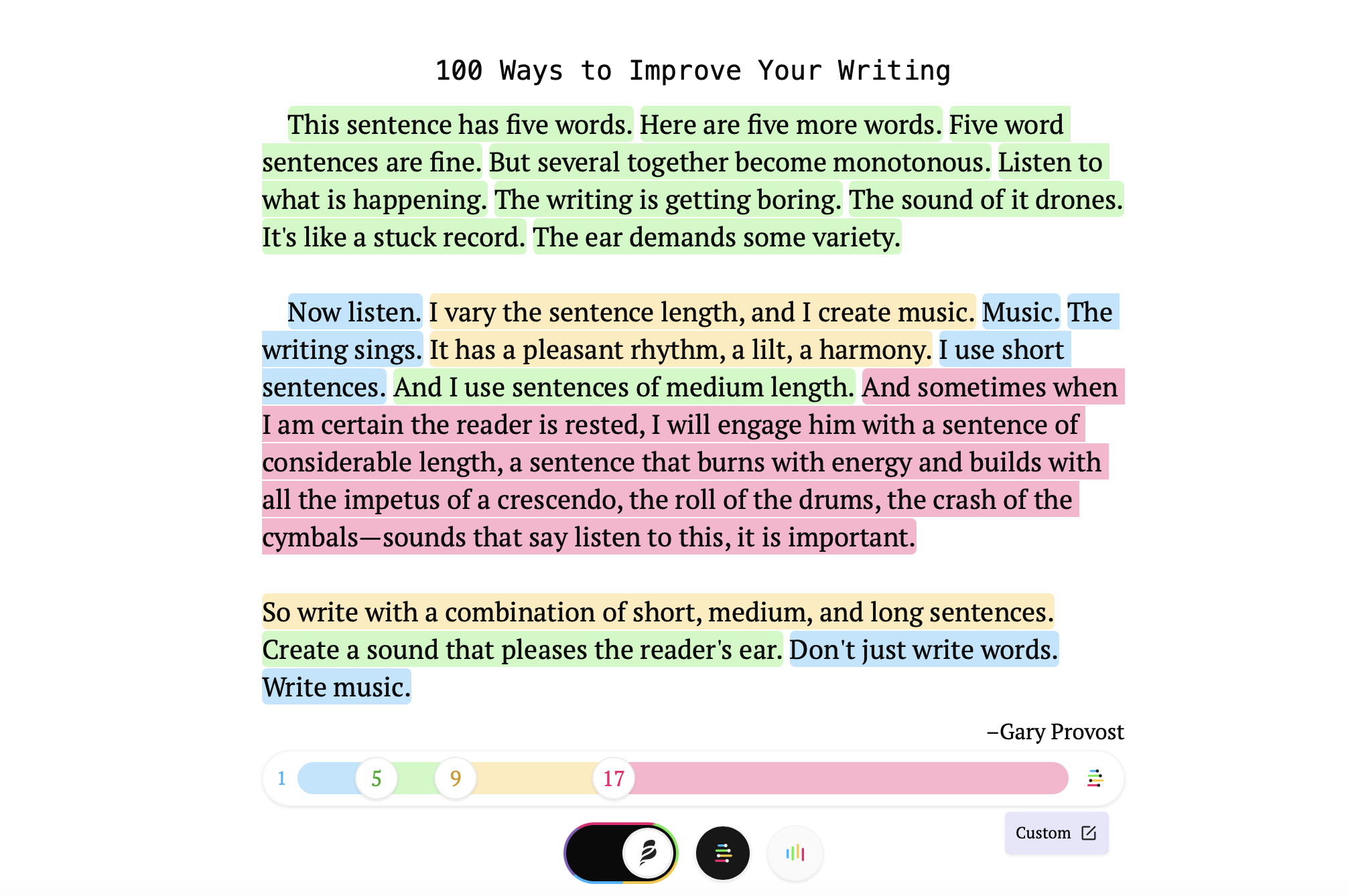
If you paste the paragraph into Beampen you will see each sentence turn a specific color based on length. In the example above you probably see a row of medium sentences. Maybe one leans long but the overall feel is a single block of color.
Then you open the Rhythm Chart. The three sentences become three bars of similar height. There is no clear rise or drop. No surprise. No soft landing. The chart shows you what your gut already knew. The rhythm is flat.
When you can see that, you can change it on purpose instead of guessing.
Step 3: Mark The Line That Deserves Emphasis
Now pick one idea in the paragraph that deserves the strongest emphasis. Only one. If you try to highlight everything, you highlight nothing.
In the example, you decided that the key idea is simple. Revision becomes easier when you follow a process. You want the reader to feel that as the takeaway.
You can mark that sentence in your mind or even comment it in your draft. That line will guide your edits. The rest of the paragraph should support it.
Step 4: Use Position To Strengthen Emphasis
Where you place a sentence in a paragraph changes how strong it feels. Beginnings and endings carry more weight than the middle.
If you want a line to feel important, you can move it toward the end of the paragraph or give it space near a break. The eye slows down at edges. You can use that natural pause as a spotlight.
In the original paragraph, the key idea about a simple process sits at the end of a long sentence. It shares space with other thoughts. You can give it more focus by letting it stand closer to the end.
Try moving your most important sentence to the final position or at least closer to it. You do not have to change any words yet. You are only rearranging the order.
Step 5: Shape The Sentence Length Pattern
Once the key line is in place you can adjust length around it. You are building a pattern that leads the reader there with intention.
One simple pattern for a persuasive paragraph looks like this:
- Medium sentence to set the idea
- Longer sentence to explain or empathize
- Shorter sentence that lands the point
If you revise the example paragraph with that pattern in mind, you might move toward something like this:
“Revision matters because it is where you actually sharpen what you meant to say. You might avoid it because it feels slow and you already spent so much energy getting words on the page, so opening the draft again seems heavy. When you follow a simple revision rhythm, the work feels smaller and you can improve each paragraph without dreading the process.”
The first sentence is medium. The second runs longer and leans into emotion. The last is a little shorter and holds the promise. In Beampen you would see a clearer mix of colors and a more interesting curve in the Rhythm Chart.
Step 6: Break And Combine For Better Flow
Now that you can see the pattern, you can fine tune it by breaking or combining sentences.
Look at any line that carries two ideas. Ask which part should carry emphasis and which part can soften into the background.
If the end of a long sentence holds an important point, consider cutting before it so it can stand alone. If two short sentences feel choppy but express one thought, consider joining them with a simple connector.
Try another pass on the example, this time leaning a bit more on contrast:
“Revision is where your writing actually gets sharp. You already know that, but you might still avoid it because it feels slow and heavy after you spent your energy on the first draft. A simple rhythm makes revision smaller. One clean pass at a time. One paragraph at a time.”
Now you have a clear short opener. Then a longer line that admits how you feel. Then three short beats that break the work into pieces. In Beampen you would see the bars step down in size and feel the pace quicken at the end.
Step 7: Listen For Emphasis Without Reading The Words
When you think you are close, read the paragraph out loud. Listen to when your voice naturally slows and when it speeds up. You are listening for emphasis, not grammar.
If you hear yourself racing through a key idea, shorten the sentence before it. If you hear yourself dragging a minor detail, either cut it or trim the line so it takes less space in the reader's ear.
You can also skim visually. Cover most of the page and leave only this paragraph visible. The shape of the lines will hint at the rhythm. A paragraph made of identical blocks feels stiff. A paragraph with variation feels more alive.
How Beampen Keeps You In Control While You Revise
You can do all of this on paper, but Beampen speeds it up without taking control away from you.
When you paste a paragraph into Beampen, Flow Coloring marks your short, medium, long and extra long sentences. The Rhythm Chart stacks them in order. Your eyes see pattern faster than your inner critic ever could.
You can click any bar in the Rhythm Chart to jump straight to that sentence. That means you can fix one stubborn line without losing your place in the paragraph.
Because Beampen is a pure writing tool, it will not suggest wording or auto rewrite your work. You stay the author. The app simply shows you where your rhythm is flat and lets you decide how to change it.
If you feel stuck while revising, you can press the slash key and pull up sentence starters or your own custom prompts. These do not replace your voice. They nudge you back into motion so you can keep shaping the paragraph yourself.
A Simple Checklist For Rhythm Focused Revision
When you want to revise a paragraph using only rhythm and emphasis, you can follow this quick checklist inside Beampen or any editor you like:
- Choose the paragraph and decide what it should do
- Identify the single most important line
- Move that line toward the end or another strong position
- Use Flow Coloring or a quick scan to spot flat stretches
- Adjust sentence lengths to create contrast around the key idea
- Break or combine sentences that blur emphasis
- Read aloud and listen for where the stress naturally falls
You will notice that none of these steps require new ideas. You are not inventing new content. You are sculpting the rhythm of what you already have so the meaning hits the way you want.
Your Next Paragraph Is Already Better Than You Think
The difference between a flat paragraph and a compelling one often has less to do with genius and more to do with rhythm. You can learn to feel that rhythm. You can learn to shape it on purpose.
If you want a clear view of your sentences while you revise, you can try Beampen today. You get visual rhythm, real time highlighting and a writer's block helper, all without AI touching your voice.
Your ideas are already on the page. Rhythm and emphasis help you make them unforgettable.